
Building Affordable Rental Housing with GABG and Kratos
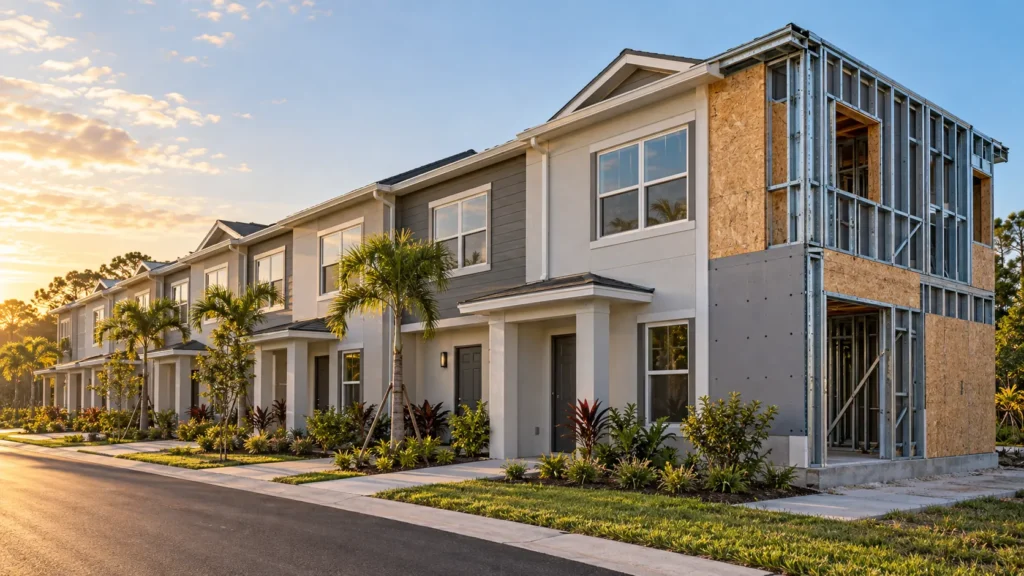
Building rental housing that people can afford requires more than finding a promising location. A project must also control construction costs, meet local demand, and remain viable after land, financing, insurance, and operating expenses are included.
GABG Real Estate Development Group is developing a repeatable approach to attainable rental housing, beginning with opportunities in Florida. Kratos, its construction product platform, is part of that approach. By using repeatable building components and a more consistent construction process, GABG aims to manage project costs while delivering durable homes suited to each market.
How Kratos Supports Rental Development
A rental development succeeds when the finished property can attract residents at rents that support its full cost of ownership. Construction is a major part of that equation, but delays, material waste, maintenance, and energy use also affect long-term performance.
Kratos is intended to help GABG plan and deliver projects through repeatable components, efficient material use, and consistent quality control. Its building envelope can be designed around project-specific durability and energy-performance requirements.
The goal is not to build an identical property everywhere. GABG can reuse parts of a proven construction approach while adapting each development to its site, local building codes, climate, zoning requirements, and prospective residents.
Any claim about a particular project’s structural performance, fire rating, energy savings, or long-term cost must be supported by its engineering, testing, specifications, and approvals.
Why the Construction Cost Basis Matters
A lower, more predictable construction cost basis can give a rental project more flexibility. It may allow a development to offer rents that fit the local market, absorb concessions during lease-up, or remain viable if costs rise elsewhere in the budget.
GABG has used $169 per gross square foot as an initial hard-cost planning assumption for a proposed Kratos-based housing concept. This is a feasibility starting point—not a construction quote, a guaranteed price, or the total cost of a completed development.
Hard costs generally cover the physical construction work. A full development budget must also account for items such as land, sitework, utilities, permits, design, insurance, financing, taxes, lease-up, and reserves. Contractor pricing and the exact scope must be confirmed for each site.
For example, consider a proposed 10-unit townhome development with 1,859 square feet per unit, or 18,590 gross square feet in total:
| Illustrative cost item | Amount |
|---|---|
| Initial hard cost at $169 per square foot | $3,141,710 |
| Construction contingency at 10% of initial hard cost | $314,171 |
| Contractor overhead and profit at 6% of initial hard cost | $188,503 |
| Development fee at 4% of initial hard cost | $125,668 |
| Preliminary subtotal | $3,770,052 |
That preliminary subtotal is about $202.80 per gross square foot, before land, site-specific soft costs, financing, and other project expenses. The example shows how quickly a starting construction figure changes as additional cost layers are included.
Actual pricing will vary with labor, materials, freight, site conditions, utilities, local codes, insurance requirements, and the contractor’s scope. GABG’s process is to test an initial concept against local conditions, then replace planning assumptions with a project-specific budget.
Turning Construction Costs Into a Viable Rental Project
A competitive construction cost does not, by itself, make a rental development successful. The property must also earn enough income after vacancy, concessions, operating expenses, reserves, and debt service.
Using the same 10-unit townhome concept, monthly rent of $2,200 to $3,000 per unit would produce $264,000 to $360,000 in annual scheduled gross rent if every unit were occupied and paid the stated rent for all 12 months. If each lease included one free month, first-year gross rent would instead be about $242,000 to $330,000, before other deductions.
These are illustrations, not forecasts for a specific GABG property. They are not net operating income, cap rates, cash returns, or projected investment returns. Each proposed development needs current local rental comparables and a complete financial model.
Rental concessions make this especially relevant. Realtor.com reported that 43.5% of studio, one-bedroom, and two-bedroom rental listings across the 50 largest U.S. metropolitan areas offered concessions in August 2026. That figure describes a broad set of listings; it is not a direct comparison for a larger townhome. It does show why a development should be evaluated using achievable effective rent, rather than advertised rent alone. Read the Realtor.com rental report. Realtor.com Economic Research
Why Market Selection Comes First
Florida offers a range of potential rental markets, but conditions differ sharply between cities and neighborhoods. A project that works in one location may face very different land prices, insurance costs, competition, renter demand, and lease-up timing in another.
That is why GABG’s development approach begins with the location and the intended resident. Before advancing a site, the team must evaluate local employment and housing demand, comparable rents, competing supply, construction costs, zoning, and the time it may take to fill the property.
A lower construction basis is most useful when paired with a product that people in that market need and can afford. It should not be used to justify a project in an oversupplied location or to assume that future rent increases will solve an otherwise weak budget.
A Repeatable Approach Across Different Jurisdictions
GABG’s longer-term strategy is to apply a disciplined development process beyond its initial Florida focus. Kratos may provide a repeatable construction platform, but every new jurisdiction requires its own review of market conditions, site approvals, building codes, contractor licensing, insurance, taxes, and project costs.
The NASCLA Accredited Examination can provide a trade-exam pathway through participating state agencies. Passing the exam does not grant a nationwide contractor license. Contractors must still apply through the relevant licensing agency and meet its additional requirements. See NASCLA’s participating agencies and examination guidance. nascla.org
For GABG, the opportunity is to carry a tested development and construction process into suitable markets while treating each location as a separate business and compliance decision.
GABG’s Development Process
Before committing to a rental project, GABG’s approach is to:
- Identify a location and the households the development would serve.
- Compare the proposed homes with current local rental properties.
- Estimate achievable rent, concessions, vacancy, and lease-up time.
- Obtain site-specific construction pricing and confirm the Kratos scope.
- Account for land, sitework, permits, insurance, financing, operations, and reserves.
- Test the project under less favorable cost, rent, and timing scenarios.
A project should move forward when its location, housing product, construction plan, and financial assumptions work together—not simply because one headline cost or rent figure looks attractive.
Building for Attainability and Long-Term Value
GABG Real Estate Development Group sees Kratos as a practical tool for creating attainable, durable rental housing. A repeatable construction platform may help control the cost and complexity of development, while careful market selection helps ensure the finished homes meet local demand.
The measure of success is a completed property that serves residents and remains financially sound through changing market conditions. That requires project-specific design, pricing, approvals, and underwriting at every stage.
Interested in discussing a development opportunity? Contact GABG Real Estate Development Group to explore the site, market, and construction requirements.
The costs, rents, and development scenario in this article are illustrative. They are not a bid, financing offer, or guarantee of occupancy, valuation, or investment return. Project decisions require current local data, contractor pricing, engineering, legal review, and lender underwriting.